
How carbon measurement helps create better event decisions
How event carbon measurement is helping the University of Birmingham prioritise action, support clients and build a stronger evidence base for sustainable events
82%
less catering emissions, thanks to carbon-conscious choices
You can't really change what you don't measure.
Annaliese Stanton, Event Project Manager, University of Birmingham
The University of Birmingham hosts hundreds of conferences, meetings and academic events each year, welcoming delegates from across the UK and around the world. As expectations around environmental reporting continue to grow, the University’s Venues & Events team recognised an opportunity to move beyond broad sustainability commitments and through event carbon measurement, begin reporting on the environmental impact of events in a consistent, evidence-based way.
Instead of waiting for reporting requirements to become mandatory, the team launched a pilot project using TRACE to measure five representative events, ranging from smaller UK-based meetings to large international conferences. The objective was to establish a meaningful baseline, understand where the greatest impacts lay and identify practical opportunities to reduce them.
Over time, the ambition is to build a library of typical carbon profiles for different event types, enabling both the University and its clients to make better-informed decisions before events take place.
The pilot has already influenced operational planning, strengthened conversations with clients and demonstrated how robust carbon measurement can support service development. It has also reinforced an important principle that now underpins the University’s approach to creating more sustainable events: meaningful decisions require meaningful data.
The challenge
The University had already embedded sustainability across many aspects of its events operation, but understanding the true carbon impact of individual events remained a challenge. While the team knew that areas such as catering, waste and travel were likely to influence an event’s footprint, it lacked the evidence needed to quantify those impacts or demonstrate where changes would make the greatest difference.
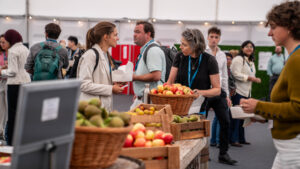
The pilot was designed to address that gap. Five events were selected to represent different event types, with the Royal Geographical Society’s annual conference providing the most detailed case study. Hosting around 2,000 delegates each day over several days, it offered a valuable opportunity to measure an event at scale and compare a more traditional delivery model with one that embedded a range of sustainable interventions throughout planning and delivery. These included carbon-rated menus, sustainability-focused suppliers, compostable food service items and dedicated composting waste streams, alongside detailed measurement of travel, energy use, materials and other event activities.
Rather than asking whether more sustainable choices were worthwhile in principle, the team wanted to understand their measurable impact. As Annaliese Stanton explains: “We all kind of know we shouldn’t really get on planes that much. We shouldn’t really eat much meat… but we don’t know the data behind it. So we’re trying to say you can’t really change what you don’t measure.”
The aim was also forward-looking. Beyond understanding individual events, the University wanted to build a stronger evidence base that could support clients, strengthen conference bids and eventually form part of a carbon profiling service offered alongside event management.
What the data showed
The pilot confirmed that travel dominates the carbon footprint of many academic conferences. Across the five events measured, 99.77% of emissions fell within Scope 3, with delegate travel accounting for by far the largest share of the overall footprint. Operational emissions under the University’s direct influence represented only a small proportion of the overall footprint, highlighting both the scale of the travel challenge and the importance of helping delegates make more sustainable transport choices.
When delegate travel was excluded, average operational emissions across the five events were 7.94 tCO₂e per event, very close to the TRACE industry benchmark of 7.61 tCO₂e. That gave the team confidence that its venues and core event operations were already broadly aligned with wider sector practice, while highlighting travel as the biggest remaining challenge.
“The reality is that we had very little control over delegate travel… That kind of gave us a focus really for future events… actually the biggest impact we can have for us personally is waste and food.”
—Annaliese Stanton, Event Project Manager, University of Birmingham
At first glance, the Royal Geographical Society conference appeared to reinforce this conclusion. Comparing the event with and without the sustainable measures introduced during planning showed only around a one per cent reduction in total emissions once international travel was included. However, analysing the data differently revealed a much more significant story.
When delegate travel was removed from the comparison and the analysis focused only on the aspects of the event that the University could directly influence, operational emissions fell by more than 71%. Those changes avoided almost 11 tonnes of CO₂e through measures that were entirely within the University’s control.
Looking more closely still, the combination of lower-carbon catering choices and compostable serveware reduced catering-related emissions by more than 82%, demonstrating that procurement and planning decisions could deliver substantial reductions where organisers have direct control. Food and serveware alone accounted for more than 10 tonnes of avoided emissions, making them the single most effective operational intervention identified during the pilot.
With this new data, the team could now prioritise the areas capable of delivering the greatest measurable impact, focusing time and resources where they were most likely to make a difference.
The pilot also demonstrated the value of measurement beyond individual projects. By analysing multiple events, the University began building a clearer understanding of what a typical carbon profile looks like for different conference formats.
As that dataset grows, the team expects to benchmark similar events, identify recurring hotspots and provide clients with evidence that supports decisions before an event takes place, rather than simply reporting its impact afterwards, allowing sustainability considerations to be built into event design and procurement from the outset. That shift from retrospective reporting towards predictive planning is now one of the University’s longer-term ambitions.

Decisions made
The pilot quickly moved beyond measurement and into practical action. While the data confirmed that delegate travel was the largest contributor to overall event emissions, it also identified where the University could have the greatest influence through its own operations.
One of the first initiatives to emerge was working with a rail operator to encourage lower-carbon travel by offering delegates discounted train travel. Although international travel will remain a significant source of emissions for many conferences, the pilot showed that the University also has an important role to play in shaping delegate choices through practical incentives and better information. Beyond identifying travel as the biggest challenge, the findings are helping the team focus its time, resources and investment where it can make the greatest difference.
Within the University’s direct control, the findings have reinforced a series of operational priorities. Catering strategies are being reviewed to further reduce emissions and food waste, sustainable menus continue to be developed, and the success of compostable serveware at the Royal Geographical Society conference has informed discussions about wider adoption across suitable events.
Alongside this, the team has reviewed its wider procurement approach, identifying opportunities to work with more sustainable suppliers and reduce the number of deliveries by consolidating orders wherever possible. The pilot has strengthened collaboration between catering, waste management, sustainability and event delivery teams, ensuring that carbon considerations are embedded earlier in the planning process rather than addressed after an event has taken place.
Perhaps most importantly, the team is beginning to use the data proactively. Instead of waiting until an event has finished to understand its impact, the ambition is to build typical carbon profiles for different event formats, allowing clients to understand the likely implications of choices such as delegate travel, menu design and event duration during the planning stage.
“The plan is that we hope to sell the service to a client and say that we can create a carbon profile for their event using TRACE.”
—Annaliese Stanton, Event Project Manager, University of Birmingham
That data is also creating new opportunities. The University intends to offer event carbon profiling as a value-added service alongside event management, providing clients with detailed carbon reports and practical recommendations tailored to their events, helping them identify where environmental improvements and more efficient use of resources can be achieved together.
At the same time, the growing dataset will strengthen support for academics bidding to host conferences by providing indicative carbon data and demonstrating how sustainability has been considered from the outset.
Repeated reporting will also improve understanding over time. As more events are measured using a consistent methodology, the University expects to build increasingly robust benchmarks for different event types, compare performance year on year and identify recurring opportunities for improvement. Rather than treating each event as a standalone exercise, every report contributes to a growing evidence base that informs future decision-making across the wider portfolio.
See more success stories
An insight into how Jack Morton uses data-driven design to deliver lower-carbon event experiences

Showcasing art and sustainability with ‘The Dalmore Presents…’ by Chorus Arts
How Lime Venue Portfolio measured the carbon emissions of their exhibition stand with TRACE
‘Inspiring a better Britain’: how TRO delivered for the inaugural edition of Anthropy with TRACE
Factory 42 put the ‘Green’ in BBC Studios The Green Planet AR Experience with TRACE